
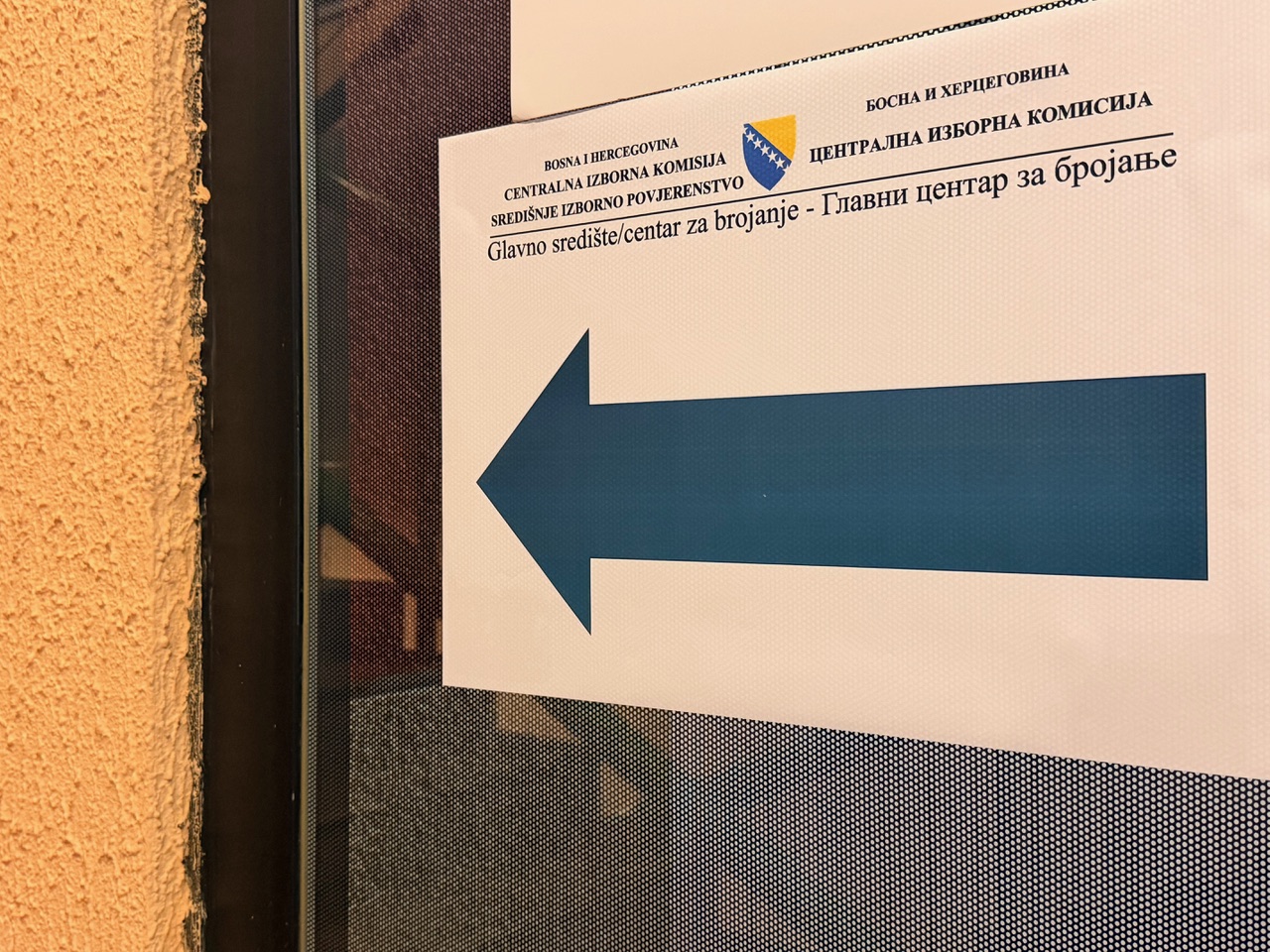
At the Main Counting Center, there is none of the ceremony that accompanies election day—no crowds in school hallways, no ballot boxes, no nervous whispering in voting booths. Democracy is not celebrated here; it is dissected. In a hangar of light and plastic, behind improvised barriers and tables scattered with paper, votes are reset to zero and counted again—this time under the cold eye of cameras, supervisors, and observers who try to remain neutral while watching history being rewritten with a ballpoint pen.
Something in the air
Independent observers from the Pod Lupom Coalition monitored the work of the Main Counting Center on days when recounts were repeatedly conducted from polling stations in Republika Srpska, due to suspicions surrounding the results of the snap elections for president of that entity.
From the inside, the procedure looks orderly, almost sterile: several tables operate simultaneously, each in its own fenced “booth,” like small workstations in a pretentiously modern open-space office. Direct communication with counters is not allowed: between observers and the rolled ballots stands a rule—and the person who embodies it—the supervisor assigned to each table. If you have a question, you don’t address the five-person team reviewing ballots, but the supervisor, who then, sometimes patiently and sometimes mechanically, responds or, in rare cases, shows the disputed ballot for inspection.
At first glance, this seems like protection of the process: preventing pressure, noise, and “cheering” from the audience. But in practice, this layer of mediation becomes a filter, soundproofing between those who count and those who observe. Everything happens quickly enough for you to miss a detail, and slowly enough to exhaust you.
Governmental non-governmental organizations
What makes the space tense is not only the sound of paper rustling under fingers, but the mix of people there for entirely different reasons. Among the observers are representatives of political parties and various associations. And here, within the first few hours, a pattern emerges: some “independent” observers from associations appear to work in tandem with party representatives. This is especially evident during breaks, in hallways and around coffee machines. They exchange information, coordinate where they will stand, and return to the same table as if synchronized.
Center staff, it seems, know what they are looking at—a political extension in civil society clothing. But the system recognizes only paper: accreditation. Formally and legally, if you enter as an association, then you are an association. You don’t have to explain whom you hug during breaks. In this way, the ban on having two observers from the same political party at one counting table is bypassed: one carries party accreditation, the other accreditation from an “association,” yet they behave as a single team.
Different interpretations of the same thing
As the counting progresses, you realize that one of the key words is interpretation. And unsurprisingly, it mirrors the worn-out phrase politicians often serve us. One political party announces an objection because teams, they say, interpret invalid ballots differently. The same situation, different outcomes: at one table a ballot is declared invalid, at another valid.
It’s the kind of disagreement that sounds technical and harmless, but carries enormous weight: the fate of a single vote depends on who is sitting at the table and how strictly they read the rules. And when elections are decided by hundreds, sometimes by dozens of votes, “interpretation” stops being a manual term and becomes a political fact.
Most suspicions, however, do not revolve around nuances, but around recurring patterns that feel almost banal. Observers report situations where there is suspicion that an “x” was added to otherwise valid ballots—just enough to have the vote declared invalid. In a room where everyone tries to sound rational, it’s an accusation that hangs in the air like the smell of smoke: hard to prove in the moment, but too frequent to ignore. And if we as observers have learned anything over a decade of monitoring elections in Bosnia and Herzegovina, it’s this—where there is smoke, there is fire.
Then evidence emerges of votes being wrongly attributed: results that belonged to one candidate ended up assigned to another.
In such moments, while the supervisor explains the procedure and the team continues stacking ballots into piles, you get the feeling that an error can be presented as coincidence—and that coincidence can be repeated often enough to become an organized system.
Even more alarming is what emerges from the arithmetic itself: the number of votes exceeds the number of people signed on the voter list for that polling station. This is not a dispute over interpretation—it is simply impossible. In that case, mathematics becomes the witness.
But that’s not all… call now and you get elections
And then there are ballots without security features, without stamps. Paper that looks like a ballot, behaves like a ballot, enters counting as a ballot—but lacks what would make it unquestionably authentic. In every country, in every system, a security feature is the line between “we believe” and “we know.” When that line is missing, the space fills with suspicion.
At the Pod Lupom Coalition, we do what observers most often do in silence, without the right to intervene or slow the process: we observe carefully, take notes, assemble fragments into a picture. We compare results from polling stations with those obtained after recounts.
And as counting continues, everything becomes less abstract. This is no longer a story about “procedures” and “standards,” but about people whose single vote may have disappeared between two interpretations, between two piles of paper, between one added mark. According to the data, at least 827 votes were stolen, nearly 1,000 people voted without valid documents, and at multiple polling stations there is suspicion of forged voter signatures.
These are findings of the Central Election Commission and independent observers, based on comparisons between polling-station results and recount results—not a court verdict—but they are concrete enough to demand answers.
Summa summarum, without profanity: the truth sets you free
In rooms like these, truth rarely appears dramatically. It comes as a subtle fatigue in the eyes of counters, as nervous flipping through rulebooks and procedures, as an observer’s gaze lingering too long on a single pile of ballots. It also comes as the feeling that the system is complicated yet too porous: enough rules to explain everything, enough loopholes to abuse everything.
When you step outside, the air feels cleaner even though the air-quality index has reached 300, and the city sounds normal. But normality is deceptive. Because inside, behind barriers and tables, the democratic ritual is stripped of romance and reduced to what it truly is: an administrative process that depends on trust. And trust, once eroded, is not restored by recounts—it is restored only by clear answers: who stole, and will anyone face consequences.
For an independent observer, the greatest lesson is not that irregularities necessarily occur, but that without constant oversight and full transparency, they can occur “quietly”: through interpretations, through procedures, through a single added mark on paper. And that is, in a country where every election carries the weight of the future, far too quiet for something that should be loud—the truth.