


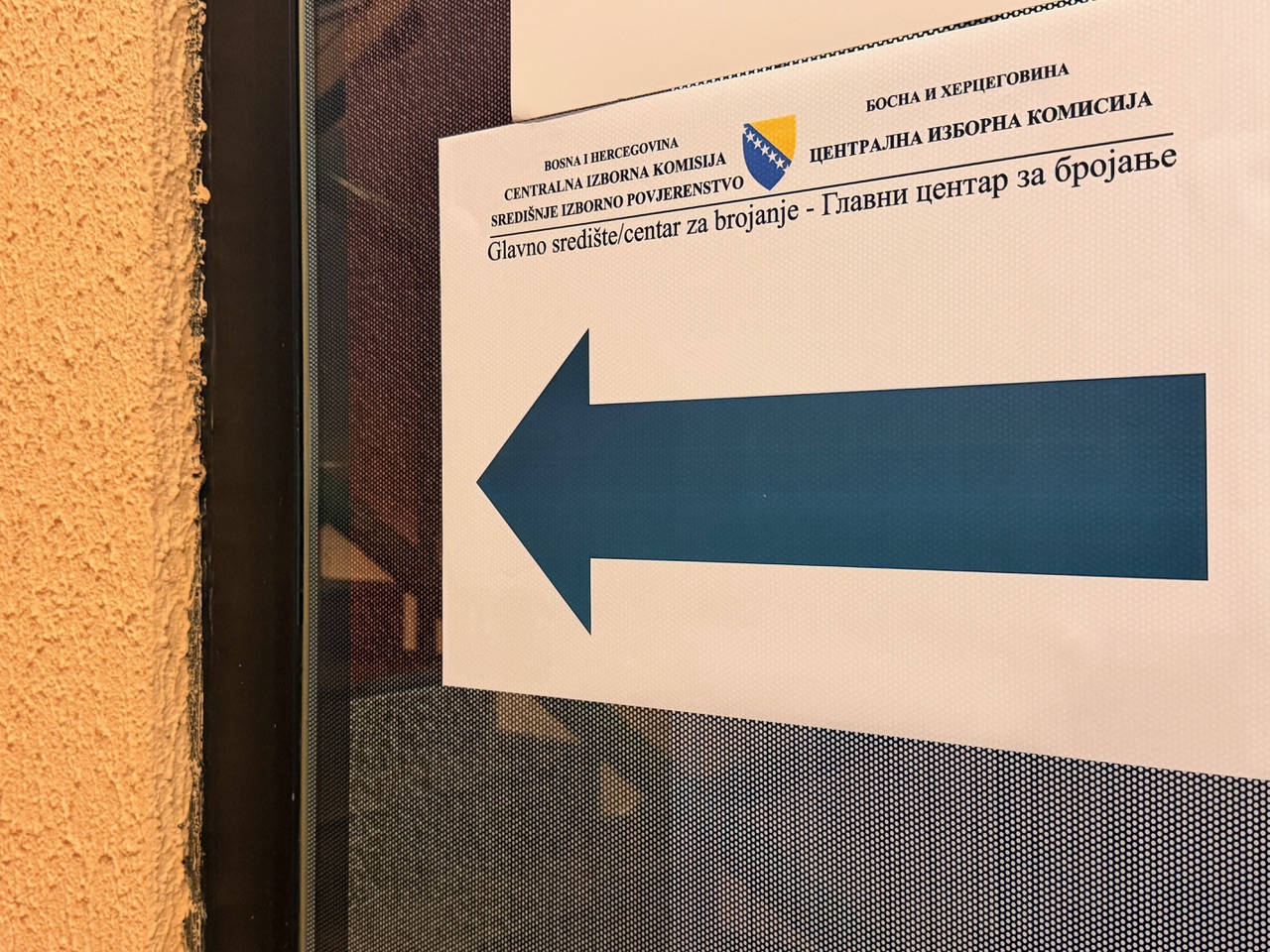
The work of the Main Counting Centre differs significantly from the atmosphere that characterizes election day at polling stations. There are no crowded school corridors, ballot boxes, or direct contact with voters. Instead, in a controlled environment, behind improvised barriers and worktables covered with electoral materials, votes are recounted. This process takes place under the supervision of cameras, supervisors, and observers, in a setting where democratic will is not expressed, but rather verified and scrutinized.
Independent observers of the Coalition Pod lupom monitored the work of the Main Counting Centre during repeated recounts from polling stations in Republika Srpska, conducted due to doubts regarding the results of the Early Presidential Elections in that entity.
From an internal perspective, the procedure appears formally structured and strictly regulated. Multiple teams work simultaneously in separate, enclosed areas, in accordance with clearly prescribed rules. Direct communication between observers and counting teams is not permitted. Each table is assigned a supervisor who mediates communication, responds to observers’ questions, and, in rare cases, allows inspection of a disputed ballot.
At the normative level, this system is intended to protect the process from pressure and interference. In practice, however, this additional layer of mediation often functions as a filter that slows responses and complicates the timely identification of irregularities. The process is sufficiently dynamic for key details to be easily missed, yet prolonged enough to cause observer fatigue.
The Role of “Independent” Observers
The presence of diverse actors during the counting process adds an additional layer of complexity. Observers include representatives of political parties as well as civil society organizations. Within the first hours of work, patterns of behaviour emerge that call into question the genuine independence of certain organizations. During breaks and informal interactions, close coordination between some “independent” observers and party representatives becomes apparent, including the exchange of information and coordinated positioning at the same counting tables.
From a formal-legal standpoint, the system recognizes only accreditation. If an observer is accredited on behalf of an association, their relationship with political actors is not subject to further scrutiny. In practice, this circumvents the rule prohibiting the presence of more than one observer from the same political party at a single counting table: one individual holds a party accreditation, the other an association accreditation, while their actions remain coordinated.
Divergent Interpretations of Identical Situations
As the recount progresses, it becomes evident that one of the key challenges lies in differing interpretations of electoral rules, particularly regarding the validity of ballots. Identical situations result in different decisions: a ballot deemed invalid at one table is considered valid at another.
Although such discrepancies may appear technical in nature, they carry far-reaching consequences. The fate of an individual vote depends on the assessment of the counting team and the consistency with which rules are applied. In electoral processes where margins between candidates are minimal, “interpretation” shifts from an administrative concept to a politically consequential fact.
Further concern arises from recurring patterns of suspected irregularities. Observers recorded cases in which there is a reasonable suspicion that marks were subsequently added to otherwise valid ballots in order to render them invalid. While such actions are difficult to prove at the moment they occur, their frequency warrants serious attention.
Cases of incorrect allocation of votes were also documented, whereby results were recorded in favour of candidates for whom the votes were not cast. When combined with procedural explanations, such errors are often presented as accidental, yet their repetition raises questions of systemic accountability.
Particularly alarming are instances in which the number of counted ballots exceeds the number of voters recorded on the voter register for a given polling station. This is no longer a matter of interpretation or procedural error, but an obvious inconsistency indicating a serious breach of electoral integrity.
An additional concern involves ballots lacking prescribed security features, such as official stamps. Although such ballots formally enter the counting process, the absence of basic elements of authenticity significantly undermines trust in the overall process.
Findings and Implications
In line with its role as an independent observer, the Coalition Pod lupom did not have the authority to intervene in the counting process. However, it systematically documented observed irregularities and compared results from polling stations with those obtained through recounts.
Based on available data, it was determined that at least 827 votes were lost or improperly recorded, nearly 1,000 individuals voted without valid identification documents, and there is reasonable suspicion of falsified voter signatures at multiple polling stations. These findings are based on data from the Central Election Commission of Bosnia and Herzegovina and reports by independent observers. While they do not constitute a judicial ruling, they are sufficiently serious to require clear and unambiguous responses from the competent institutions.
Concluding Observations
At the Main Counting Centre, truth rarely emerges dramatically. It is revealed gradually—through the fatigue of counting staff, inconsistent application of rules, and the sustained attention of observers to details that should not be contentious. The process is burdened by numerous procedures, yet simultaneously leaves room for their misuse.
Stripped of the symbolism of election day, the democratic process is reduced to an administrative operation entirely dependent on trust. Trust, however, is not restored through recounting alone, but through accountability and transparent answers to whether irregularities stem from error or deliberate action.
For independent observers, the key lesson is not merely that irregularities can occur, but that without continuous oversight and full transparency, they can occur quietly—through interpretations, through procedures, through a single additional mark on a piece of paper. In a country where every election carries the weight of the future, such silence is far too quiet for something that should be unequivocally loud: the truth.