


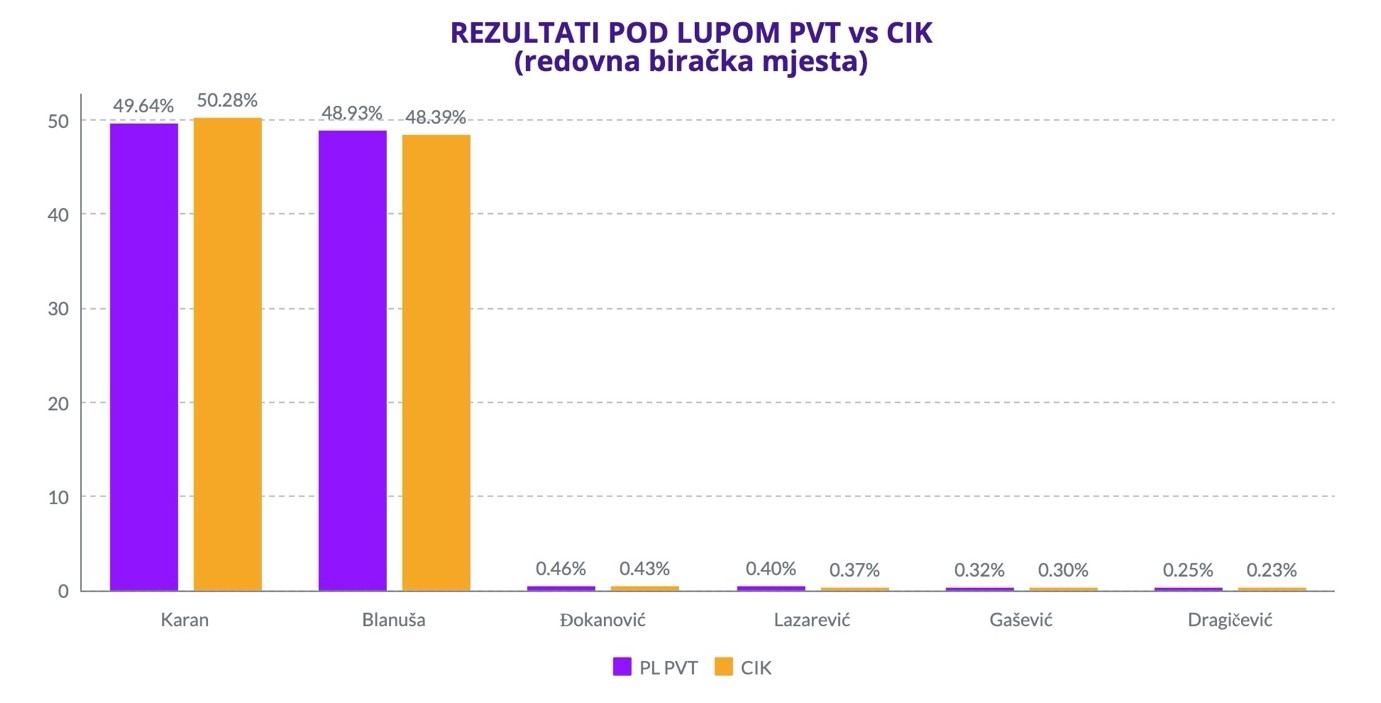
As polling station committees counted ballots and bags of election materials arrived at local election commission offices, a pattern that citizens across Bosnia and Herzegovina (BiH) have recognised for years played out once again: allegations of vote theft, pressure on voters, and election results that shift after polls close—exactly where they should already be “locked in.” According to the findings of the Pod Lupom Coalition, the snap election for President of Republika Srpska delivered a razor-thin contest, but also a series of irregularities that call into question the reliability of parts of the results.
To date, no election has been fully free and fair
The Pod Lupom Coalition assesses that these elections are no exception to the “chronic problems” of BiH’s electoral process. Irregularities, they note, begin well before election day—through unlawful pressure on voters, vote-buying, misuse of public resources, inappropriate rhetoric and hate speech, premature campaigning, and even the exploitation of children in campaign activities. On election day itself, they argue, the problem shifts to polling stations: adding votes to certain candidates, deliberately invalidating ballots cast for political opponents, forging signatures, and voting in the names of people who did not turn out.
They also warn of what frequently follows established illegal practices in BiH: sanctions—when they come at all—arrive slowly and are rarely proportionate to the irregularities and criminal offences committed. Investigations drag on for years, and serious accountability for election fraud remains rare.
The race is so tight that we cannot confirm the winner
The Pod Lupom Coalition monitored the elections using a parallel vote tabulation (PVT) methodology on a statistically representative sample of polling stations, which is used to independently verify election results—particularly in environments where public trust in the electoral process is low.
According to their data, the results they collected align with what the Central Election Commission of BiH (CEC/CIK) has published, in that both show a close contest between two candidates and one candidate leading. However, the difference between the two leading candidates in the Pod Lupom sample is 0.7%, which falls within the statistical margin of error of ±1.5%, and is noticeably smaller than the gap shown in the results determined by the CEC/CIK (the current difference between the two leading candidates on the CEC/CIK website—considering only votes from regular polling stations also observed by the Pod Lupom Coalition—is 1.89%). For this reason, the Pod Lupom Coalition cannot confirm the winner with certainty.
Eye-catching figures: 72 polling stations, at least 827 “stolen” votes
One of the most concrete parts of the monitoring findings relates to the comparison of preliminary polling-station results with the outcomes of recounts conducted at the Main Counting Centre. In a sample of 131 polling stations where votes were recounted, Pod Lupom reports that discrepancies were identified at 72 polling stations, while 59 showed no deviation. At those 72 polling stations, they claim, at least 827 votes were “stolen”: based on the processed data, 532 votes were unlawfully added to Siniša Karan, while 295 votes were deducted from Branko Blanuša. On average, around 11 votes per polling station were “stolen” where discrepancies were recorded.
The Pod Lupom Coalition also recalls the alarming scale of irregularities observed previously, particularly after the 2022 General Elections, when recounts of votes for the President of Republika Srpska pointed to organised election fraud in certain cities (Doboj, Prijedor, Zvornik)—areas that again represent the focus of the strongest suspicions of manipulation.
Observers are “guardians of voters’ will,” but not a complete safeguard
One finding stands out: the presence of independent election observers at polling stations demonstrably helps protect the will of voters. The Pod Lupom Coalition states that at polling stations where their observers were present, the number of disputed votes was “incomparably smaller”—only 28 votes were disputed at those stations, multiple times fewer than at polling stations without Pod Lupom observers, where nearly 800 votes were disputed.
At the same time, they highlight limitations of observation: observers, they claim, are often not allowed to monitor vote counting smoothly and effectively “from close proximity,” creating space for irregularities to occur even in front of those tasked with preventing them.
What the CEC/CIK should do
The Coalition states that it has submitted to the CEC/CIK an extensive documentation package related to the key monitoring findings: a preliminary assessment of election day, PVT results, a list of critical incidents, a list of reported irregularities, and lists of polling stations where discrepancies and procedural failures by polling station committees were recorded. They had also previously called on the CEC/CIK to order recounts at polling stations with “extreme values,” such as unusually high turnout or overwhelming dominance of one candidate, as well as cases where sensitive materials arrived at local election commission offices after 23:00.
The CEC/CIK has already recounted votes from 131 polling stations with suspicious values. The Coalition believes recounts should continue wherever there is a basis to do so—regardless of how much time the process requires—and that elections should be repeated and criminal complaints filed in cases where vote theft or forged voter signatures are established.
New election technologies are the number one priority for 2026
A central recommendation in the findings is the demand to introduce new election technologies at all polling stations for the 2026 General Elections: electronic voter identification and ballot scanners. Pod Lupom argues that these measures would prevent the majority of irregularities currently taking place and widely reported in recent days—from voting on behalf of others, multiple voting, and adding votes, to targeted manipulation of valid and invalid ballots and subsequent “smoothing out” of results through forms and data entry into the system.