
 BS
BS
These frequently asked questions provide a simple guide to the new voter identification and ballot scanning procedures for the 2026 General Elections: what voters need to do at the polling station, how the paper ballot is handled, and what happens to the results.
1. What are voters voting for in the 2026 General Elections?
In the 2026 General Elections, citizens will elect representatives at the state and entity levels, and at the cantonal level in the Federation of Bosnia and Herzegovina. The number and type of ballots you receive depends on whether you are voting in the Federation of Bosnia and Herzegovina or in Republika Srpska.
If you are voting in the Federation of Bosnia and Herzegovina, you will vote for:
- a member of the Presidency of Bosnia and Herzegovina,
- the House of Representatives of the Parliamentary Assembly of Bosnia and Herzegovina,
- the House of Representatives of the Parliament of the Federation of Bosnia and Herzegovina,
- the assembly of the canton in which you have the right to vote.
If you are voting in Republika Srpska, you will vote for:
- a member of the Presidency of Bosnia and Herzegovina,
- the House of Representatives of the Parliamentary Assembly of Bosnia and Herzegovina,
- the National Assembly of Republika Srpska,
- the President and Vice-Presidents of Republika Srpska.
* If you are voting in the Brčko District of BiH, the number and type of ballots you receive depend on your entity citizenship: FBiH — 3 ballots (you vote for the Presidency of BiH, the Parliamentary Assembly of BiH and the Parliament of the Federation of BiH; you do not vote for a cantonal assembly); RS — 4 ballots (the Presidency of BiH, the Parliamentary Assembly of BiH, the President and Vice-Presidents of Republika Srpska, and the National Assembly of Republika Srpska).2. What is new about the voting process in the 2026 General Elections?
Voter identification and authentication using fingerprints
Bring a valid BiH identification document with you. The biometric identification and authentication device is used to establish and confirm your identity using your fingerprint. Once the identification/authentication process is completed, a confirmation is printed for you to sign. Your signature should correspond to the signature on the identification document you presented.
New ballot design
The ballots have a new design and new instructions. Follow the instructions printed on each ballot.
When voting for a member of the Presidency of Bosnia and Herzegovina or for the President and Vice-Presidents of Republika Srpska, mark only one candidate.
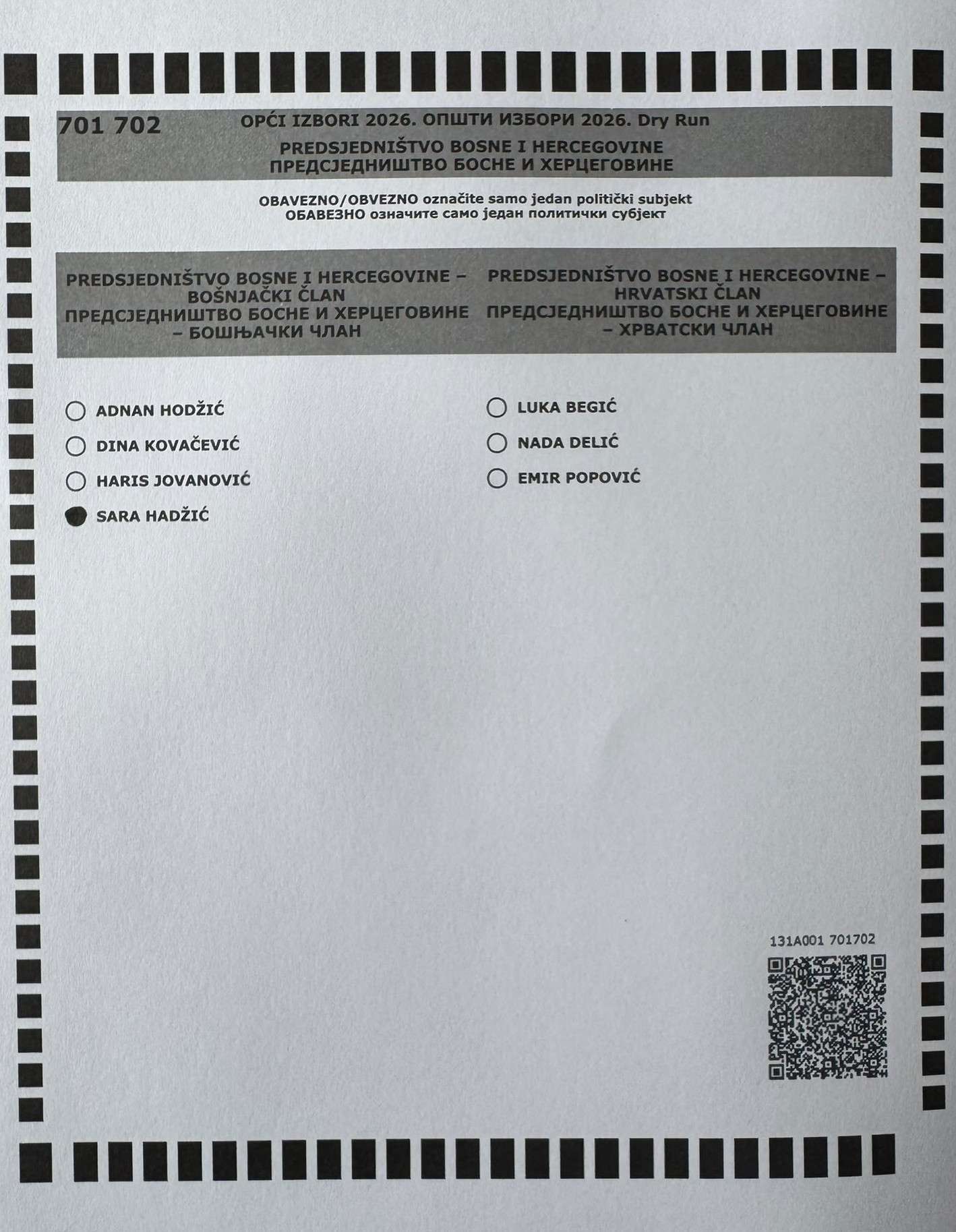
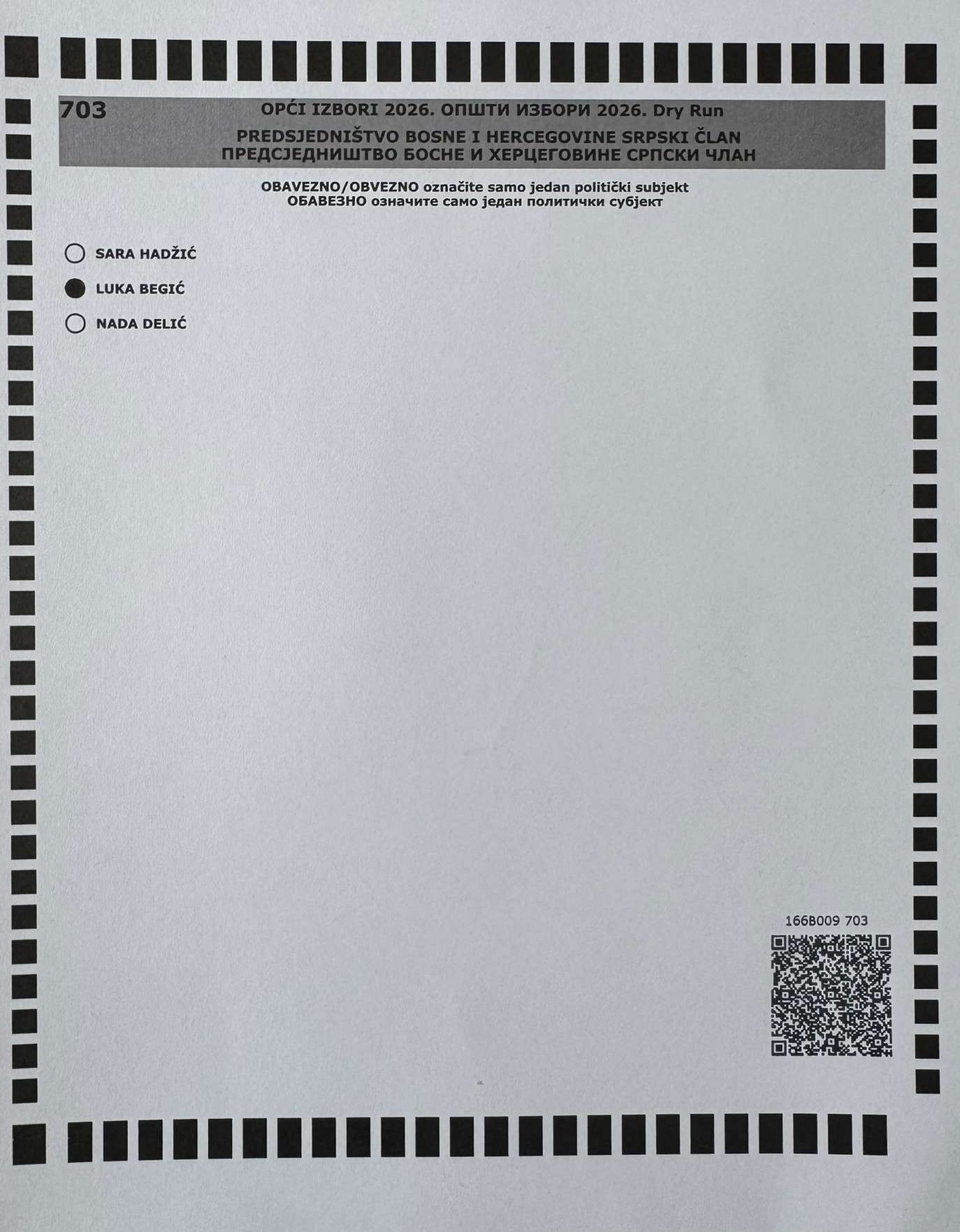
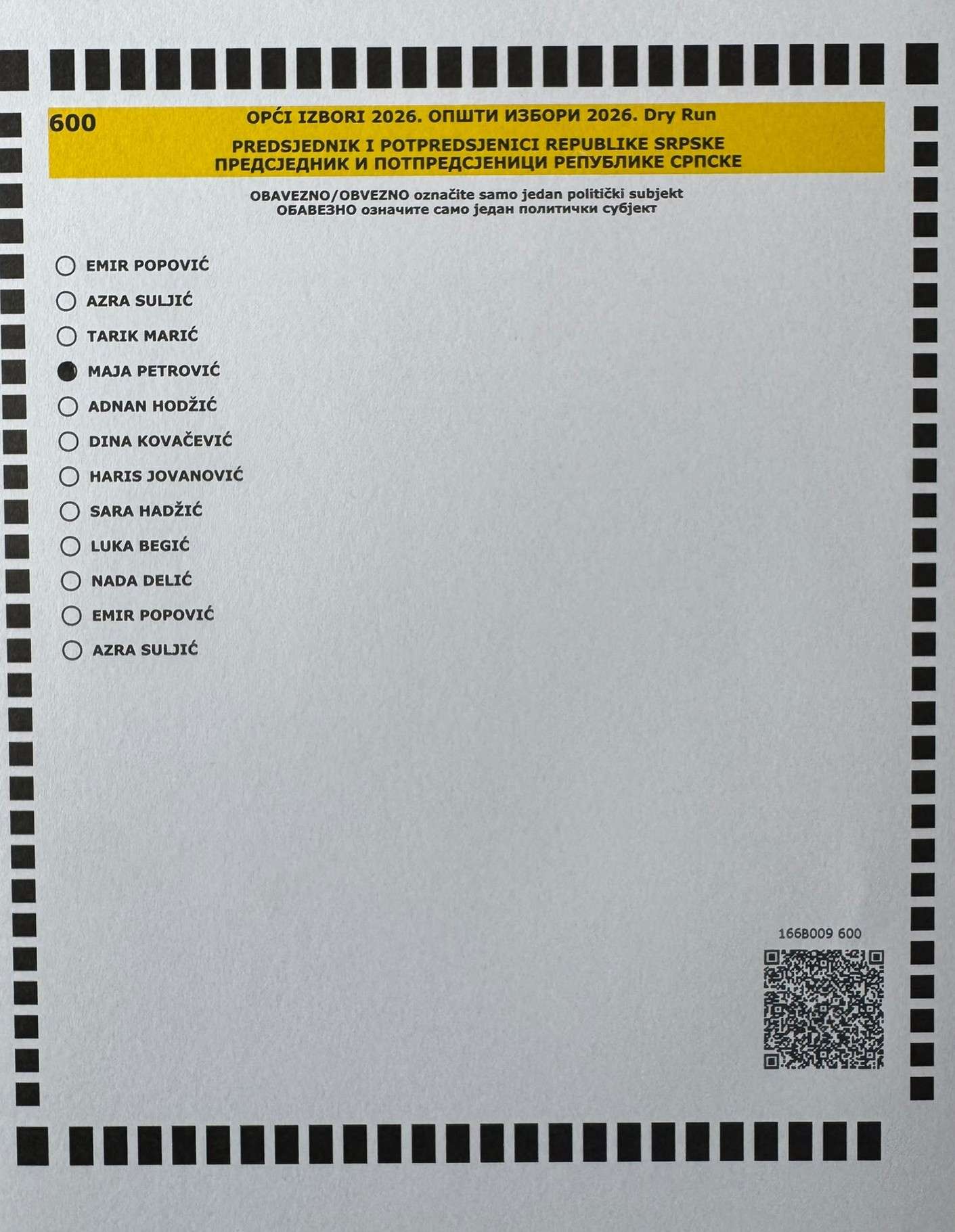
On the other ballots for different levels of government (PSBiH, PFBiH, NSRS and cantonal assemblies), mark only one political subject and up to three candidates from its candidate list.
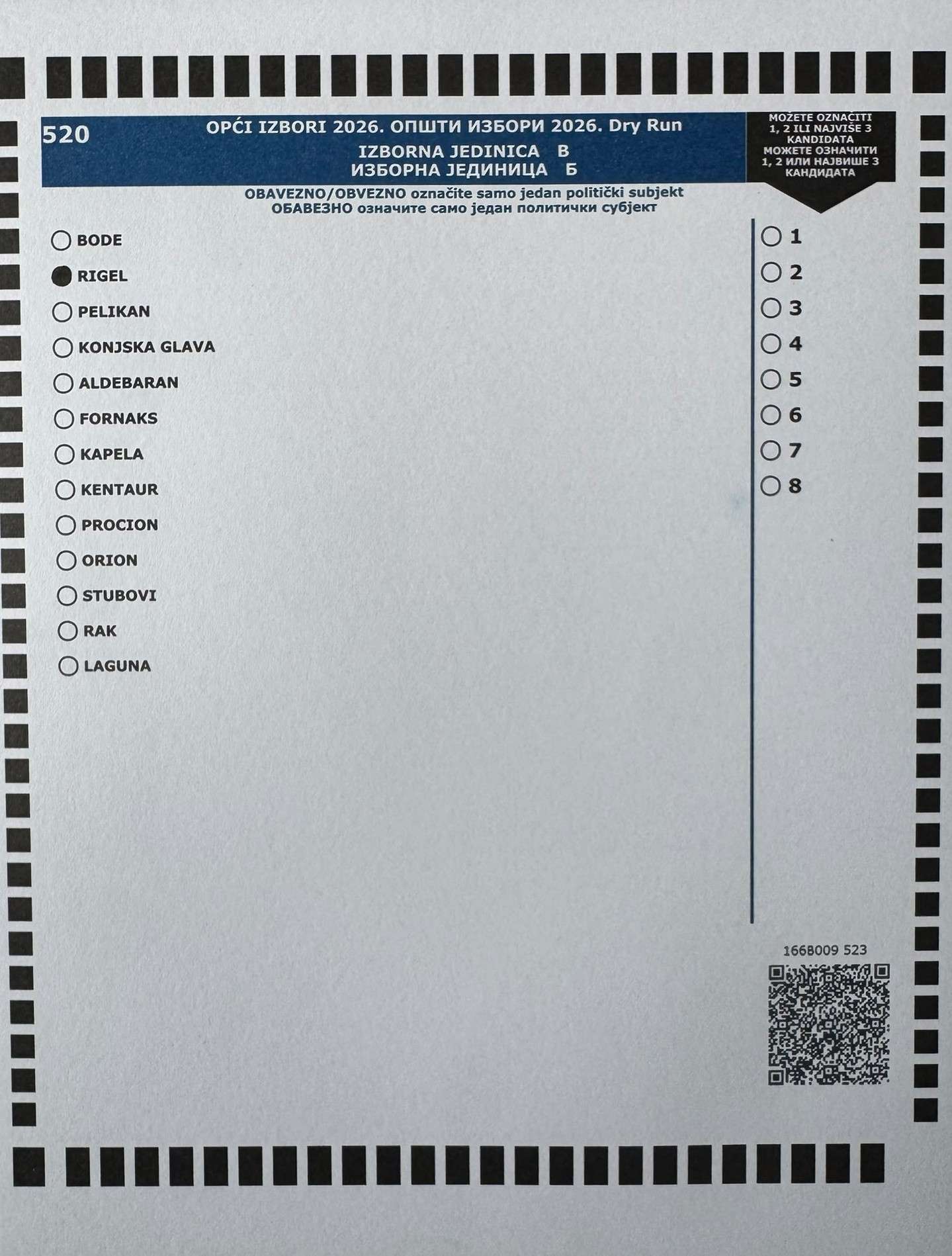
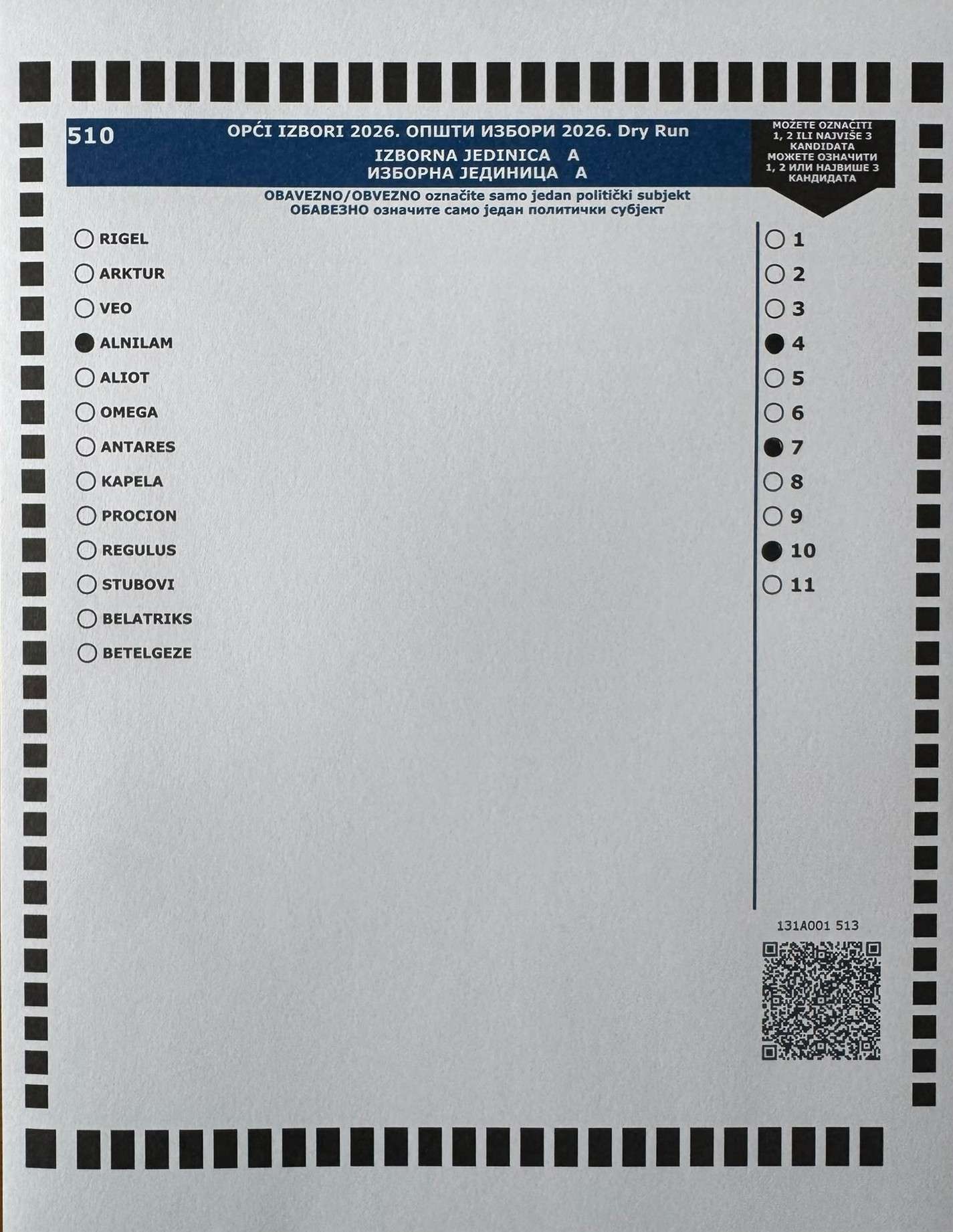
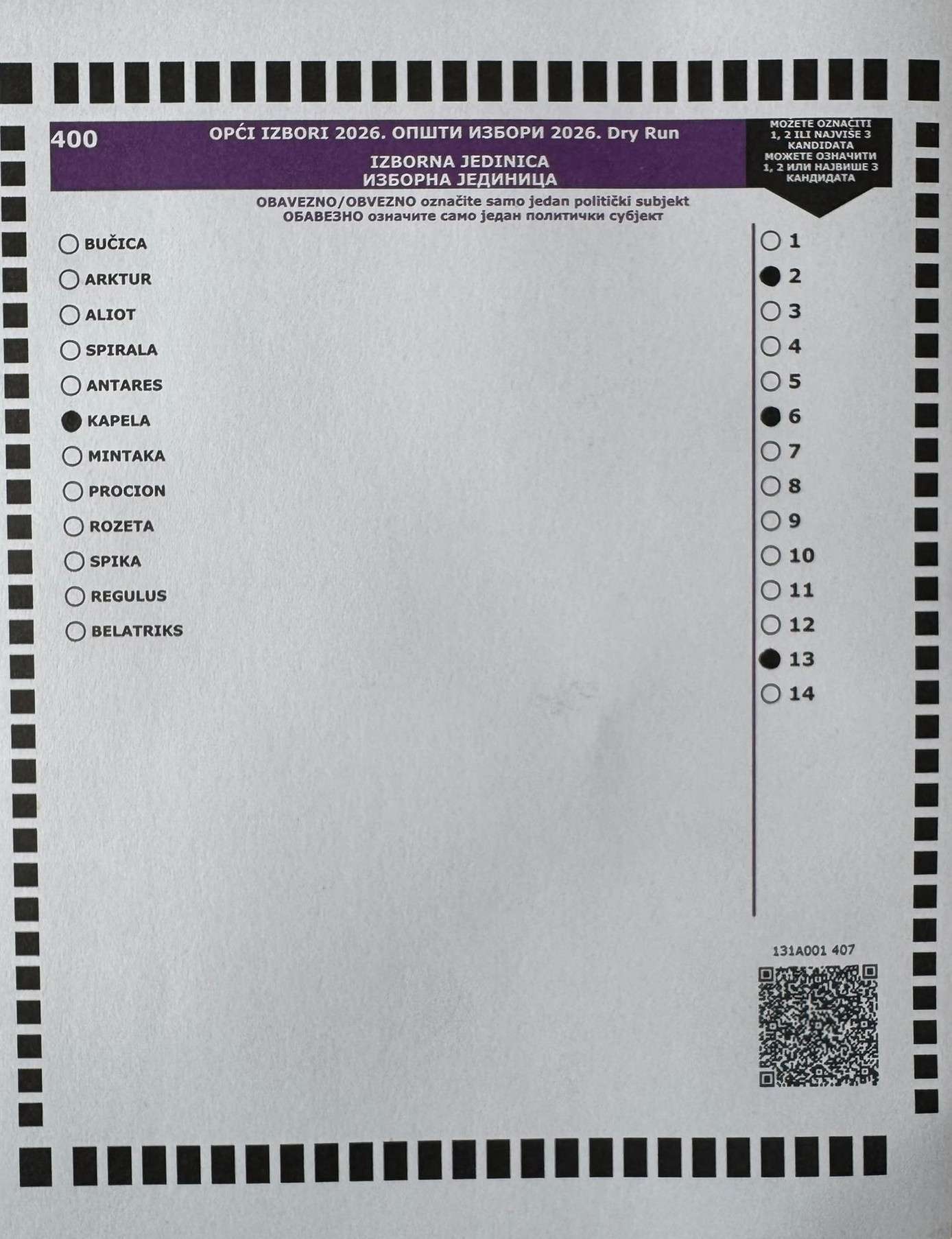
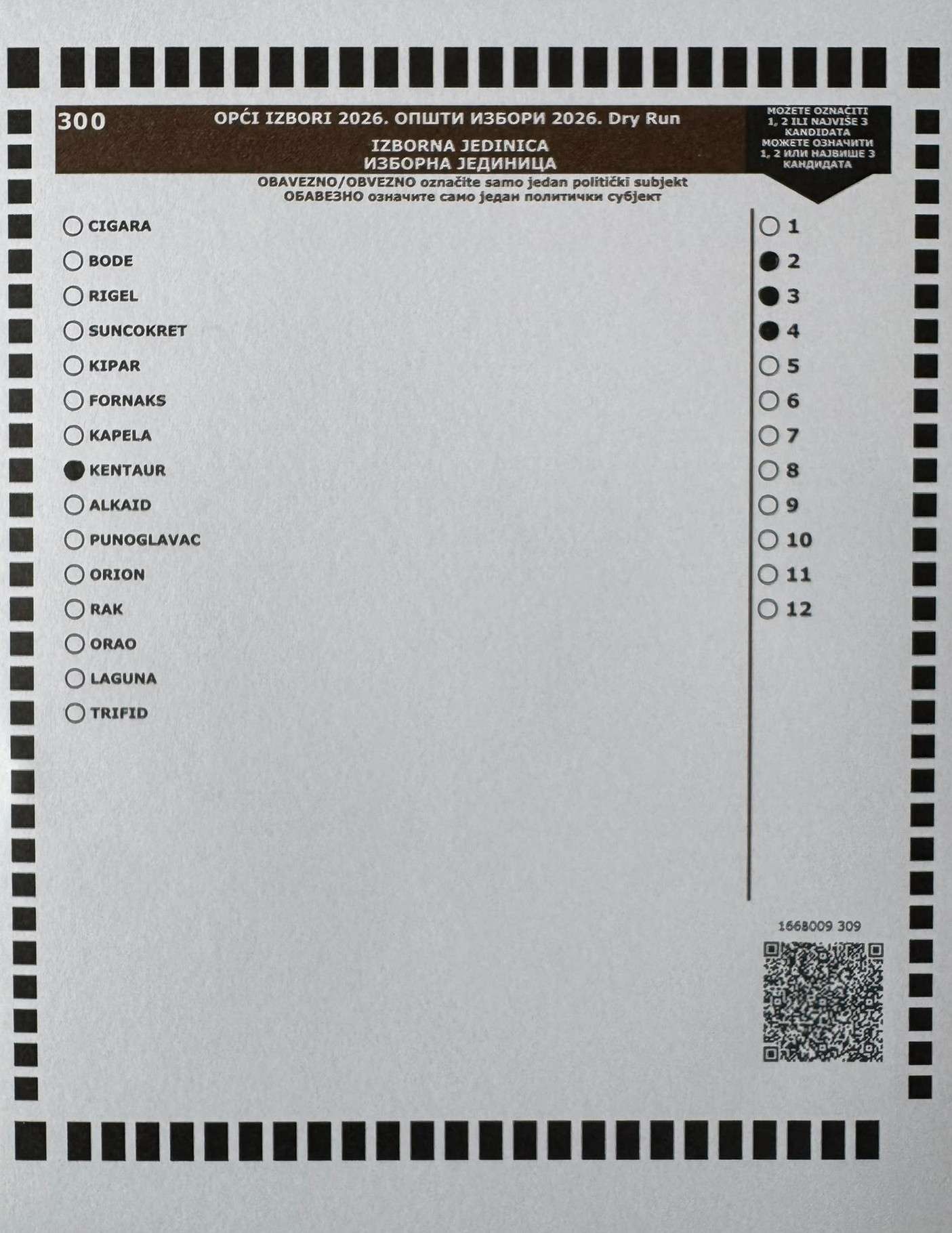
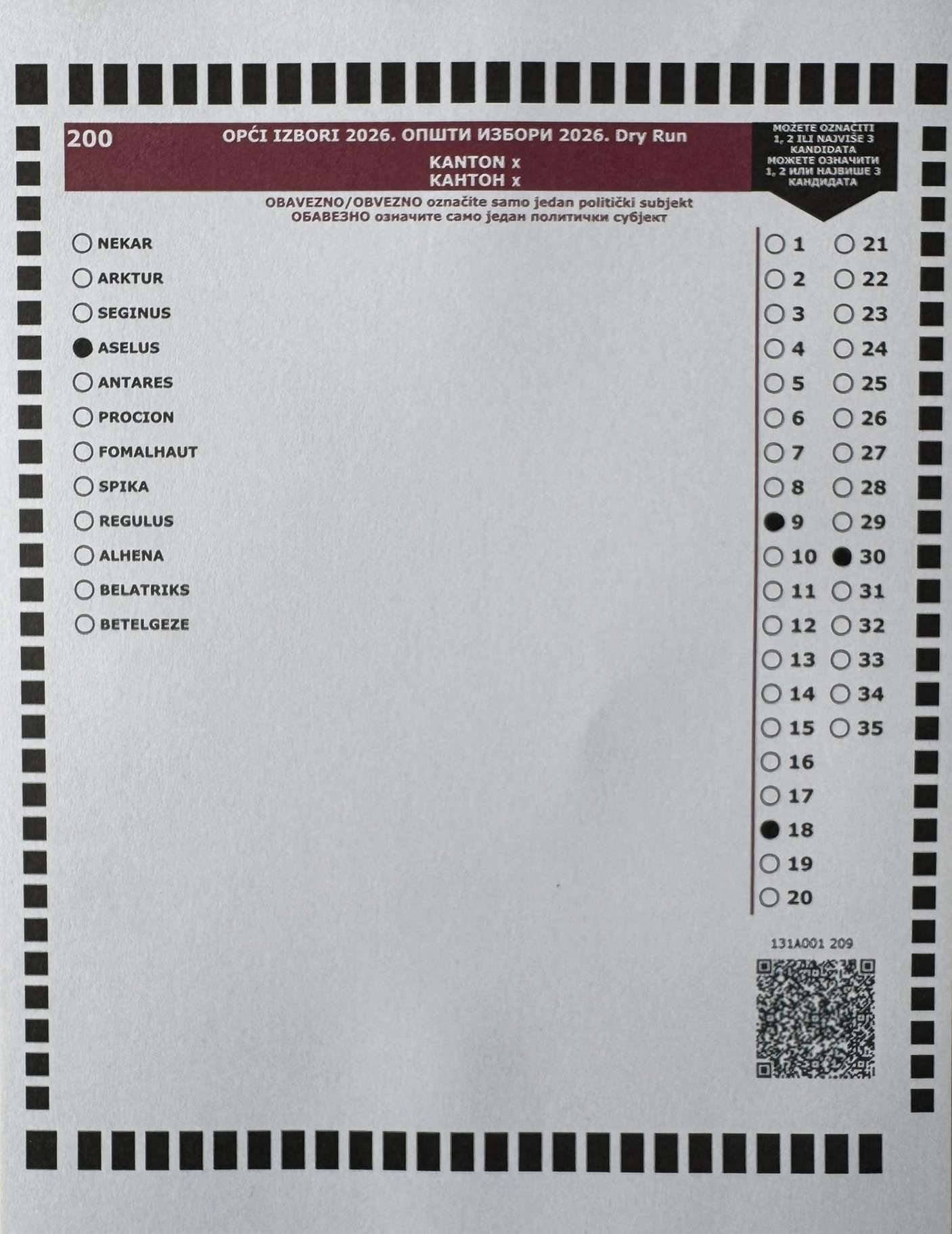
Marking the circles
Using the special marker provided in the voting booth, completely fill in the appropriate circle or circles on the ballot.
Scanning the ballots
After voting, take your ballots in the protective folder to the scanner without folding them. Personally remove each ballot from the protective folder and insert the ballots straight into the scanner opening, one at a time, to avoid jamming and ensure that all ballots are scanned properly. The scanner automatically draws in each ballot, scans it and deposits it into the ballot box.
3. What do I need to bring with me?
Bring a valid BiH identification document so that members of the polling station committee can verify your identity before issuing your ballots. This may be a valid ID card, passport or driving licence issued in BiH. You will also be asked to provide your signature as part of the identification process.
4. Can my fingerprint or identity be linked to the way I vote?
No. The biometric identification/authentication and ballot scanning procedures are separate. The biometric device is used to identify and authenticate the voter, while the scanner processes the completed ballot without linking it to the voter’s identity. The scanner does not store voters’ personal data and is not data-connected to the voter identification device. Your identity data remains separate from your ballot — your vote remains your own.
5. Can my identity be determined from my ballot?
No. The ballot is anonymous and cannot be linked to your biometric data or to the time at which you voted.
6. What if my identity cannot be verified using my fingerprint?
If fingerprint authentication cannot be completed, the chair of the polling station committee and the polling station committee member responsible for identification will verify your identity using a valid identification document. You will then sign the identification confirmation without fingerprint authentication and may continue with the voting process.
7. What does the ballot scanner do?
The scanner automatically draws in each ballot, scans it, electronically counts the votes and physically deposits the paper ballot into the ballot box. After each successful scan, a message confirming successful scanning appears on the scanner’s screen. After the polling station closes, the election results data from the scanner are transmitted to the server of the Central Election Commission of Bosnia and Herzegovina. The paper ballots remain in the ballot box and are subsequently counted manually.
8. What if my ballot cannot be scanned?
If you incorrectly mark or damage your ballot before scanning, contact a member of the polling station committee. If the ballot has become unusable, you will receive a new ballot, while the original will be marked “DAMAGED” and stored separately. If the ballot becomes crumpled or gets stuck in the scanner, ask the members of the polling station committee for assistance. They will remove it while protecting the secrecy of your vote. If the ballot is damaged during removal, you will receive a new ballot for that level of election and repeat the voting and scanning process.
9. What if the new technology stops working?
If a device stops working, follow the instructions provided by the members of the polling station committee. Technical support will attempt to resolve the problem or replace the faulty equipment. If the biometric identification and authentication device is unavailable, an approved alternative identification procedure may be applied. If the ballot scanner is unavailable, voters may continue placing paper ballots into the ballot box provided by the competent election commission.
10. What is the difference between preliminary and official results?
After the polling station closes, election results data from the scanner are transmitted to the CEC BiH server. The physical paper ballots are then counted manually at the polling station. Preliminary electronic results provide an early indication based on the electronic count. The electronic and manual results are compared and verified. Official results are established through the legally prescribed counting and verification procedures. There is expected to be a time gap between the preliminary and official results. The CEC BiH establishes and publishes the election results after consolidating the results, and confirms the results after the completion of the prescribed procedures for recounts and appeals.
11. Why was the new system introduced?
The new system was introduced to provide additional safeguards in the voter identification and vote-counting processes. Biometric verification helps confirm that the person being issued a ballot is a registered voter. Ballot scanners enable an additional electronic count that can be verified against the physical paper ballots, reducing the potential for electoral irregularities and counting errors. The new election technologies also enable the direct transmission of election results from the polling-station level, reducing the risk of manipulation of ballots during transport.
Together, these changes strengthen the accuracy, transparency and verifiability of the electoral process.